
Best Smart Air Purifiers for Large Rooms Evaluating CADR ratings, HEPA filter replacement costs, and real-time air quality monitoring for home wellness.
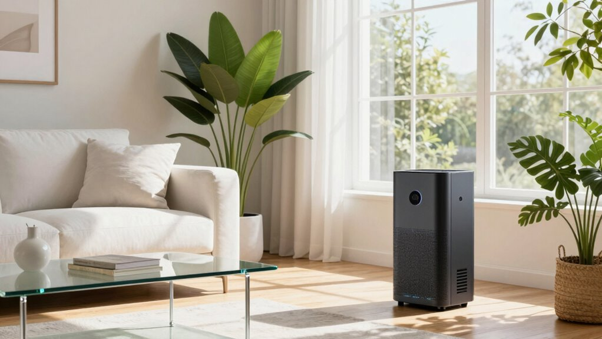
Buying a Smart Air Purifier isn’t simply about choosing between sizes and capacities or the promises that they offer, it’s about understanding three things that are not commonly explained or usually oversimplified - what CADR actually measures, what the actual cost of hosting a HEPA filter really is, and whether real-time air quality monitoring is a genuine feature or just a nice screen to look at.
Table of Contents
- Why Large Rooms Need a Different Approach
- Understanding CADR: The Number That Actually Matters
- What HEPA Filters Really Cost Over Time
- Is Real-Time Air Quality Monitoring Worth It?
- Types of Purifiers Built for Large Rooms
- How to Actually Choose
- Conclusion
Why Large Rooms Need A Different Approach
Unlike many of our digital appliances, Air purifiers are also adequately categorized and built for specific sizes and purposes. A 300-square-foot air purifier usually manages to fully cycle the air in a room measuring ~300 square feet over several times an hour, but if you place it in rooms of larger size, it will barely manage a single full cycle leaving you with poor air quality that nearly feels it hasn’t been refreshened at all. And unlike many would argue, the best efficiency won’t be found in two 300-square-foot purifiers but in one that is built for the room size, preferably one with a bit of margin to spare.
A rule of thumb that you must follow while looking for air purifiers is to ensure that your Air purifiers CADR matches at least two-thirds of your room's square footage - i.e ones that have a slightly larger capacity than the size of your rooms. When the purifier isn't struggling to work overtime or finding it difficult to cover the room, it works in more quieter and efficient ways, not leaving any room for complaints.
Understanding CADR: The Number That Actually Matters
CADR or Clean Air Delivery Rate is an estimate of how much filtered air a purifier delivers per minute, even tested separately across dust, pollen and smoke (measured in cubic feet per minute). Air purifier developers often focus on promoting their products on the values of square footage covered- and it also makes sense to us consumers but it is often a marketing tool or forefront. Instead, using the CADR, a rating measured and provided by the AHAM (the Association of Home Appliance Manufacturers) can be a more reliable and insightful assessment.
And while that distinction may not feel significant enough, it has a lot of weightage for the purifier’s performance capacity. Whenever you find a brand promoting itself with a huge number - 2,000 square feet of coverage- take it with a pinch of salt as the actual coverage is far lower than what it is marketed with.
What HEPA Filters Really Cost Over Time
In the world of Air Purifiers, the amount you pay to purchase one is merely one part of its ownership cost. True HEPA filters or the ones capturing 99.97% of particles down to 0.3 microns,typically need replacement every 6 to 12 months. Combine it with a separate activated carbon filter which actually needs replacing in an average 3 to 6 months, the cost could actually stack up! Always attempt to make an estimate of the cost of these replacements of your brand and company (generally calculate costs for a period of an entire year), and an average of the electricity it might consume in that period to actually understand the cost of your choice!
Is Real-Time Air Quality Monitoring Worth It?
When it comes to Real-Time Air Quality Monitoring, we often use it to get an estimate ourselves, but that number does much more than indicate the current AQI for our convenience. This measurement is useful to guide the Air Purifier to control its fan speed and regulate it rather than running at one fixed speed, allowing it to adapt to room setting and activities.
And it does not simply protect your electricity bills from running too high, but also ensures that your air purifier runs at maximum efficiency, while extending the life of your filter by only utilizing at high speeds when necessary. Yet what you need to mindful of, is whether the Real-Time Air Quality Monitoring is a mere display for you, or whether it is actually used to guide the purifier operations making it a useful tool!
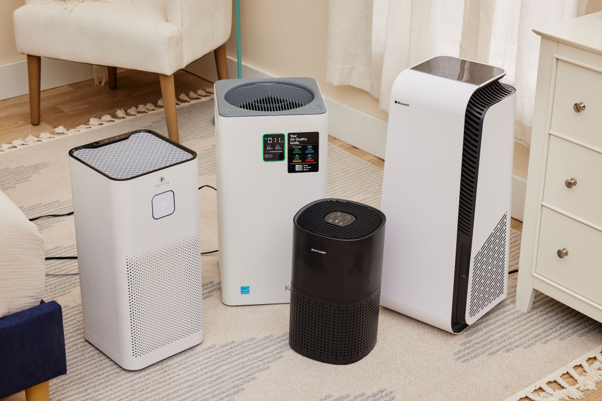
Types of Purifiers Built for Large Rooms
|
Category |
What It's Built For |
Key Tradeoff |
Best Suited For |
|
Standard HEPA |
Captures particulates — dust, pollen, general allergens |
Doesn't address gases or odors on its own |
Most typical households and general large-room use |
|
HEPA + Activated Carbon |
Adds gas and odor removal (cooking smells, smoke, VOCs) alongside particulate filtration |
Carbon media saturates faster than HEPA; combo filters may need full replacement even when only carbon is spent |
Kitchens, smokers' homes, persistent odor concerns |
|
Medical-Grade / HyperHEPA |
Captures particles smaller than standard HEPA is rated for |
Higher price point; often fewer smart features |
Severe allergies, respiratory conditions, chemical sensitivities |
|
Ionizing / Plasma-Based |
Electrically charges particles or odor molecules to help neutralize them |
Poorly designed units can produce unwanted ozone output |
Pet owners dealing with persistent dander and odor |
|
Whole-Home / HVAC-Integrated |
Filters air centrally across the whole house |
Requires professional installation; much higher upfront cost |
Larger homes needing consistent air quality throughout, rather than one room |
How do you actually choose?
Let’s break these huge challenges into a small step-by-step process:
1. Begin by getting an exact measure of your room size, not an estimate but actual square per foot measurement!
2. Filter out purifiers whose CADR covers at least two-thirds of your room footage, while prioritizing AHAM VERIFIDE-certified numbers over manufacturer claims.
3. Develop a rough estimate cost for maintenance as well as consumption that you can expect across the models you’re interested in.
4. Ensure you’re only spending on Real-Time Air Monitoring if it guides the machine, otherwise your money is better invested in a larger CADR or better quality filters!
Conclusion
When you’re choosing a Smart Air Purifier for your large rooms, it’s not simply the one which offers a large size or a bundle of features. Instead, it's one whose CADR is actually verified, whose filter costs do not burden you even after a whole year of ownership and whose smart features actually perform something smart instead of just being another mention on the spec sheet. It’s not about going out looking for the best brand name but choosing the right model - standard HEPA for a room with general particulates or HEPA plus carbon for odors and gases, medical-grade for genuine respiratory needs. Do your own research, check your own math and we can assure you that the two will outweigh any recommendation or rating that you could ever find!
Latest Posts