
FDs vs Small Savings Schemes Where Should Your Money Sit in 2026

Why This Comparison Keeps Coming Up Every Year
Every time interest rates shift even slightly, the FD-versus-small-savings debate resurfaces on personal finance forums and family WhatsApp groups alike. Part of the reason is that neither option has a permanent, obvious edge — banks revise FD rates almost continuously based on RBI policy and liquidity conditions, while the government reviews small savings scheme rates every quarter. Depending on when you're reading this, the "better" option on paper can shift by a percentage point or more.
What doesn't change nearly as often, though, is the deeper structural difference between the two: who's backing your money, how long it's locked up, and how the tax treatment actually plays out. That's the part worth understanding properly, rather than chasing whichever headline rate looks highest this month.
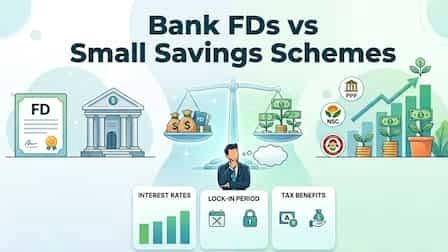
Where the Rates Actually Stand Right Now
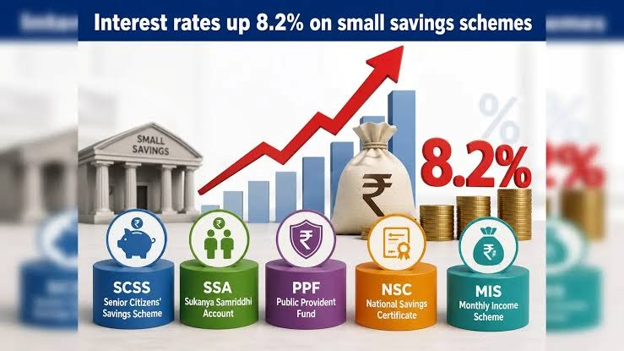
As of mid-2026, small savings schemes are holding fairly competitive ground. The Public Provident Fund (PPF) currently offers 7.1%, the National Savings Certificate (NSC) sits at 7.7%, and the Senior Citizen Savings Scheme (SCSS) and Sukanya Samriddhi Yojana (SSY) both lead the pack at 8.2%. Post Office five-year time deposits currently pay 7.5%, roughly matching Kisan Vikas Patra, which doubles your money over 115 months at the same rate.
Bank FDs, meanwhile, are all over the map depending on the bank and tenure. Large public sector banks like SBI are generally offering somewhere in the 6.3%–6.95% range for general depositors, with senior citizens picking up an extra 0.5% on top. Private banks like HDFC and ICICI are broadly similar, clustering around 6.5%–7.1% depending on tenure, though smaller finance banks have been pushing senior citizen rates as high as 8.6% in some cases to attract deposits.
Put plainly: for a straightforward comparison, SCSS and SSY currently beat almost every mainstream bank FD rate, NSC edges out most bank offerings too, and PPF sits roughly in line with typical bank FD rates rather than clearly ahead or behind.
The Safety Question: Who's Actually Backing Your Money?
This is where small savings schemes have a structural edge that doesn't show up in the interest rate alone. PPF, NSC, SCSS, and SSY are all backed directly by the Government of India — there's no institution-specific risk involved. Bank FDs, by contrast, are insured only up to ₹5 lakh per depositor per bank under DICGC coverage. For most retail savers keeping amounts well under that threshold, this distinction barely matters in practice. But for larger deposits, or for genuinely risk-averse investors, sovereign backing without a coverage ceiling is a real, meaningful advantage that small savings schemes offer and FDs simply can't match.
Liquidity: Where FDs Clearly Win
This is small savings schemes' obvious weak spot. PPF locks your money for 15 years, with only limited partial withdrawal allowed after the seventh year. NSC has a fixed five-year term with no premature withdrawal in most circumstances. SCSS and SSY come with their own multi-year lock-ins and specific eligibility rules — SCSS is restricted to those above 60, and SSY only to accounts opened for a girl child under 10.
Bank FDs, by comparison, offer far more flexibility. You can choose tenures from as short as seven days up to ten years, and while premature withdrawal does carry a penalty — typically around 0.5%–1% off the applicable rate — it's a genuinely available option rather than a locked door. If there's any real chance you'll need this money before your goal horizon, that flexibility is worth more than a marginally higher rate on a scheme you can't touch.
Tax Treatment: The Detail Most People Miss
Here's where small savings schemes often pull ahead in ways that don't show up in a simple rate comparison. PPF is fully tax-exempt on contributions, interest, and maturity amount — the classic "EEE" status under the old tax regime. NSC investments qualify for Section 80C deduction too, though the interest itself is taxable, and SCSS interest is fully taxable but paid out quarterly, which retirees often value for regular income.
FD interest, by contrast, is fully taxable at your income slab rate, and TDS kicks in once interest crosses ₹40,000 in a year for regular depositors, or ₹50,000–₹1 lakh for senior citizens depending on the bank. If you're in a higher tax bracket, that difference in after-tax returns can be more significant than the headline interest rate gap suggests.
So, Where Should Your Money Actually Sit?
Realistically, treat this as a portfolio question rather than an either-or decision. If you're building an emergency fund or saving for something within the next one to three years, a bank FD's flexibility and shorter tenures make more sense. If you're investing toward retirement, a child's education or marriage, or simply want to maximize Section 80C tax savings, PPF, NSC, SCSS, or SSY (depending on your eligibility) generally deliver better risk-adjusted, after-tax returns over the long run.
Most conservative Indian investors end up using both, and that's not indecision — it's a genuinely sound approach. Keep liquid, near-term money in FDs, and direct your longer-horizon, tax-conscious savings into the small savings scheme that matches your specific situation.
Latest Posts