
Niacinamide vs. Vitamin C Serums Whats the Ideal Choice to Fight Hyperpigmentation
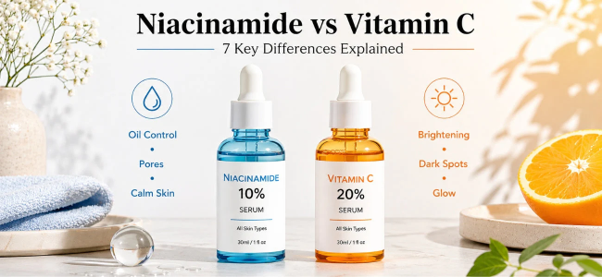
But how do you make the choice? Surely the one with the better packaging and more value for money becomes the ideal choice? Perhaps not! While it's not clearly evident what sets both of these apart and how the two are different, these two aren’t quite doing the same job. It’s true that they both help you manage hyperpigmentation, but they do it through two different strategies and mechanisms and choosing the one that suits your skin needs, is where the key is.
Table of Contents
- How Each Ingredient Actually Works
- Niacinamide vs. Vitamin C: Side-by-Side Comparison
- Pros and Cons of Each
- Which One Should You Choose?
- What Neither Serum Can Fix on Its Own
- Conclusion
How Each Ingredient Actually Works
Vitamin C, commonly present in the form of L-absorbic acid works by inhibiting tyrosinase - the enzyme that causes melanin production in your skin. This enables cutting off the pigmentation from its source, before its even produced within your skin. Vitamin C is also an effective antioxidant, i.e it also protects your skin from being damaged by sun exposure and pollution, both critical enablers of melanin production. Vitamin C’s ability to destroy melanin production at its root as well as limit external enablers is crucial in making it a popular choice and providing the effectiveness it guarantees.
Niacinamide or Vitamin B3 takes a slightly different functioning route. It tackles pigmentation by interfering with melanosome transfer, the pigment which is produced and delivered up to your skin. It acts as a soothing catalyst allowing your skin to heal from inflammation and strengthening the skin barriers making it an effective choice against post-acne marks where inflammation along with sun exposure is driving the pigmentation in your skin.
The Weighed Value of the Two
Niacinamide
Pros:
- Gentle enough for daily use
- Plays well with almost every other active ingredient
- Doubles as a barrier-repair ingredient
- Low risk of irritation even for sensitive or reactive skin.
Cons:
- Results build slowly,
- Less effective on its own for deep, sun-driven pigmentation that needs melanin production stopped at the source rather than just slowed on its way to the surface.
Vitamin C
Pros:
- Noticeably faster brightening in many people
- Adds real antioxidant protection against daily environmental damage
- Supports a fresher, more even overall complexion.
Cons:
- Formulation matters enormously — a poorly stabilized or oxidized vitamin C serum (one that's turned yellow or brown) can be not just useless but mildly irritating, and higher concentrations can sting on sensitive skin.
Niacinamide vs. Vitamin C: Side-by-Side Comparison
|
Niacinamide |
Vitamin C |
|
|
Primary Mechanism |
Blocks melanosome transfer |
Inhibits melanin production (tyrosinase) |
|
Best Suited For |
Post-acne marks, sensitive skin, inflammation-driven discoloration |
Sun-related dark spots, dullness, prevention |
|
Typical Time for Effective Results |
6-8 Weeks |
4–6 weeks |
|
Stability |
Very stable; easy to formulate and pair with other actives |
Less stable; can oxidize and lose potency if poorly formulated or stored |
|
Sensitivity Risk |
Low; well tolerated by most skin types |
Higher at strong concentrations; can cause tingling or redness |
|
Effective Concentration Range |
Roughly 5–10% |
Roughly 10–20%, depending on formulation |
|
Added Benefits |
Barrier support, anti-inflammatory |
Antioxidant protection, mild collagen support |
Which One Should You Choose?
Now that we’ve understood how the two are different and the way they impact our skin, let’s navigate the avenue of choosing between the two. The choice crucially depends on your understanding of your skin as well as the condition that has developed. If your dark spots are the aftermath from acne or a rash, your skin would be more likely to react easily to new products, making Niacinamide a safer option to calm the inflammation as well as begin to treat discoloration and prevent further damage.
Similarly, if your skin damage/pigmentation stems from sun damage, patches or unevenness in skin tone or a general lack of glow, you should lean towards Vitamin C for faster and deeper results as your skin should be able to tolerate active substances well. And if you’re unsure about the cause or perhaps find yourself in the crosshairs of both, implementing one after the other gradually after a period of two to three weeks would be the dermatologically smart way of blending them into your regular skincare routine!
What Neither Serum Can Fix on Its Own
The most crucial point of discussion that is often missed in product comparisons, is that no active ingredient or lotion, regardless of how well-formulated, can truly outpace or make up for our levels of regular sun exposure. The UV rays enable the melanocytes in our skin to pigment heavily, to the extent that weeks and months of skincare could be overpowered by a single afternoon of sun exposure! Thus, it's crucial to complement these serums with a broad-spectrum SPF 30 or higher, providing an additional layer of security from the harmful rays of the sun.
And of course, it’s also crucial to remain patient, consistent and dedicated through the process. Both Niacinamide as well as Vitamin C serums take nearly weeks of consistent usage to tackle the deep-set pigmentation in our bodies and to bring visible change and using a range of skincare products or regularly exfoliating and maintaining skin hygiene could also impact the speed and quality of the results on your skin!
Conclusion
It’s safe to say that the Niacinamide versus Vitamin C Serum debate isn’t nearly about what’s better, it’s really about which ingredient suits the kind of hyperpigmentation that you’re dealing with and how your skin responds to these new activities. Niacinamide tends to take a steadier path, being more suitable for sensitive skin, or for those who experience inflammation. Vitamin C on the other hand, focuses on faster brightening and deep antioxidant protection, combatting sun-related spots and general dullness at the same time. And perhaps for a lot of people, individuals do not need to make a choice but utilize a thoughtful combination of the two, along with our beloved daily sunscreen of course!
Latest Posts