
Sony WF-1000XM5 vs. Bose QuietComfort Ultra Evaluating noise cancellation, sound quality, and long-wear comfort.

But the Sony headphones have longer battery life, better quality of the sound, and smaller size. Choose Bose if you want peace and quiet, but pick Sony if you value the sound quality and battery life more.
Quick Note Before You Buy
Sony has since released the WF-1000XM6, so if you're shopping brand new rather than working with a deal on the XM5, it's worth knowing a newer model exists. That said, the WF-1000XM5 remains widely available and heavily discounted compared to its launch price, which is exactly why this matchup against the Bose QuietComfort Ultra is still one people search for constantly. This guide treats the XM5 as what it actually is right now: a proven, still-excellent pair of earbuds at a much friendlier price than when it launched.
Noise Cancellation: Bose Still Wins, But Not By as Much as You'd Think
Let's just say it upfront, because there's no point burying the lede: Bose remains the noise cancellation leader here, and has for years. The QuietComfort Ultra uses CustomTune technology, which measures your specific ear canal acoustics the moment you put the buds in, then calibrates the ANC profile around that data. The result is noise cancellation that adapts to you rather than applying a one-size-fits-all filter, and it shows in real-world use — engine drone, HVAC hum, and low-frequency rumble get flattened more thoroughly than almost anything else on the market.
Sony isn't exactly getting outclassed here, though. The WF-1000XM5 delivers genuinely strong ANC, and for most everyday situations — a commute, an open office, a flight — you're not going to feel shortchanged. It's more accurate to say Bose wins a specialized competition among audio enthusiasts than to say Sony's noise cancellation is a weak point. If you fly constantly or work in a genuinely loud environment, Bose's edge is worth chasing. If you're dealing with normal daily noise, Sony holds its own just fine.
Sound Quality: This One's Genuinely Close, and Comes Down to Taste
Here's where things get more interesting than a simple "X wins" verdict. Sony takes a cleaner, more analytical approach to tuning, with strong bass response balanced against a detailed midrange. If you're an Android user, Sony has a real technical advantage: LDAC support lets compatible phones stream at bitrates roughly three times higher than standard AAC, which matters if you're the type who actually notices the difference between a compressed stream and a proper high-resolution file.
Bose goes a different direction entirely, leaning into a warmer, more immersive sound signature that feels less "accurate" and more "enveloping." Neither approach is objectively better — it depends entirely on whether you want your music analyzed or you want to be wrapped up in it. Sony's six-band custom EQ also gives you more room to shape the sound yourself, while Bose's three-band EQ can feel a little limiting if you like to fine-tune.
Comfort: Two Completely Different Philosophies
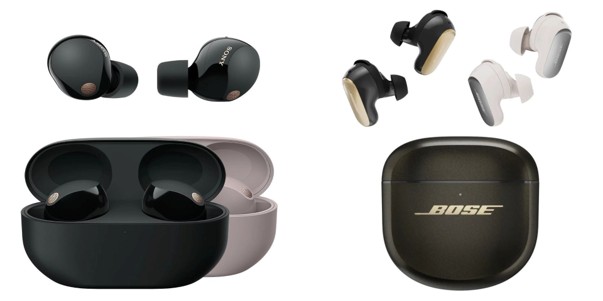
This is the category where personal ear shape matters more than any spec sheet. Sony redesigned the WF-1000XM5 to be noticeably smaller and lighter than its predecessor, relying on foam ear tips and a compact nozzle-and-sleeve design that puts the weight on your ear canal rather than the outer ear. For a lot of people, that translates into a genuinely disappearing fit — you forget you're wearing them.
Bose takes the opposite structural approach, using a stem-and-bud design supported by soft stability bands that grip the outer ear rather than relying purely on canal insertion. They're physically larger, but that added surface area actually makes them feel more secure during long stretches — think extended flights or marathon work sessions — without the fatigue that smaller, canal-only designs can sometimes cause after a few hours.
If you've had trouble keeping earbuds seated during a workout or a long commute, Bose's stability-band approach is worth trying first. If you prefer something that feels almost invisible in the ear, Sony's smaller housing has the edge.
Battery Life: Not Even Close
This isn't a subtle distinction — it is a real difference. Sony WF-1000XM5 can last up to about 12 hours with ANC switched off while still far exceeding Bose's performance with the ANC activated. The sounds provided by the Bose QuietComfort Ultra clock in at around 6 hours per charge.
For those who tend to forget to charge the buds overnight or those who are generally away from home for the entire workday plus commute, the stamina difference means something practical rather than just a piece of marketing information.
Extra Features Worth Knowing About
Bose's newly designed QuietComfort Ultra 2 came with new features such as wireless charging, upgraded spatial audio that features head tracking, and an improved transparency mode that includes hearing protection. This is good news if you are someone who often finds themselves in noisy environments and would like to have awareness of what is happening around you without exposing yourself to too much noise. At the same time, Sony came up with valuable software features of its own, such as Speak-to-Chat, which automatically reduces the volume when the user speaks, and Adaptive Sound Control, which adjusts Active Noise Cancelling and transparency depending on the user's activity.
Conclusion
If I had to draw a line in the sand, it comes down to this: Bose is built for the person who wants the quietest possible environment and doesn't mind paying a battery-life penalty for it. Sony is built for the person who wants to actually enjoy their music in detail and doesn't want to think about charging every single day. Neither choice is a compromise — it's just a different set of priorities, and that's a genuinely rare thing to say about two products competing this directly.
Latest Posts