
The App-Store Extinction Event How Zero-UI and Agentic Web Layers Are Replacing Standalone Apps
Today those tiny grid icons are still present across your screen, but your interaction with them perhaps isn’t quite the same. You see all the tasks that you did with them above, compare prices- book tickets-draft replies, are quietly sneakily happening somewhere else - inside a single conversation with an AI agent that connects with the app, evaluates your prompts and gets back with the exact information that you requested.
This shift has a name now - the App-Store Extinction Event. And it is happening - right here and now, slowly and steadily in all our daily lives! Our once-upon-a-time beloved apps are being replaced by Zero-UI Agents that substitute everything that these apps do, faster and simpler, perhaps even better!
Table of Contents
- What "Zero-UI" and "Agentic Web" Actually Mean
- What's Already Happening
- Standalone Apps vs. Agentic Web Layers
- Who Stands to Win and Lose
- What Challenges Lie in The Path?
- Conclusion
What "Zero-UI" and "Agentic Web" Actually Mean
Taking a quick insight into the world of modern-tech before we dive deeper, let’s begin by understanding what Zero-UI and Agentic Web mean to convey. Zero UI is used to describe interfaces or platforms that do not provide a distinct User Interface, but simply function on an input-processing-output format. It takes away the navigation across menus and tabs minimizing your personal mental or time-oriented investment.
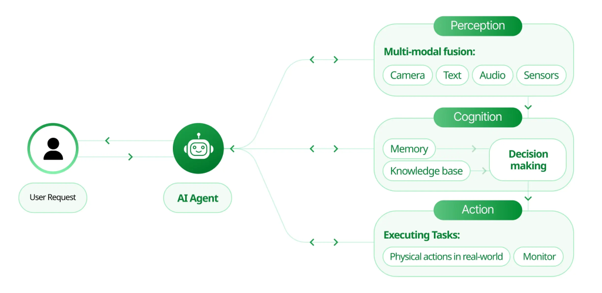
Agentic Web on the other hand, refers to the infrastructure that makes Zero-UI possible. Mainly used in the domains of AI Agents, it describes how AI agents exist within a web or a network where they can read a webpage, understand what;s on it, click-scroll-fill out forms or even perform multi-step tasks across sites and services, similar to a human, yet without a human doing any selections! When fused together, AIs functioning on both Zero-UI and Agentic Web would not require you to visit 5 separate apps or platforms to book tickets for flight, hotel stay, cab service and creating itinerary, but would take your expectations, budget, preferences and do it entirely for you!
What’s Currently Happening Around The World?
Apple: In its WWDC 26 Keynote, Apple announced that it's working on an Autonomous Agent Interface for its operating system, where the software would prioritize and assist you in what you’re trying to do instead of having to navigate and find the right buttons yourself.
Browser Integrations: Various AI platforms such as OpenAI's Atlas, Perplexity's Comet, Microsoft's Copilot Mode in Edge, and Anthropic's Claude for Chrome have all developed their Agent Modes that are fully capable of navigating websites, filling forms and completing multi-step or procedural tasks on the user’ behalf - simply with the right instructions!
And these changes aren’t simply going to impact our personal lives! Gartner has projected that by the end of 2026, over 40% of enterprise applications will also have embedded AI and a rough estimate that AI could account for enterprise application sales for as much as 30% by the end of 2035. What’s more interesting to note, Microsoft’s own research has defined 2026 as the year where apps, operating systems and websites dissolve into a unified AI web, redefining how humans search, shop, work or consume information across the internet.
Standalone Apps vs. Agentic Web Layers
|
Standalone Apps |
Agentic Web Layers |
|
|
Interaction model |
Manual navigation: menus, taps, forms |
Stated intent: agent handles the steps |
|
Distribution |
App store search, rankings, downloads |
Agent selection — which tool the AI chooses to use |
|
Multi-app tasks |
User switches between apps manually |
Agent chains tasks across services automatically |
|
Update cycle |
User-initiated app updates |
Continuous, server-side improvements |
|
Data visibility for businesses |
Clear: human traffic, trackable clicks |
Murky: agent traffic often indistinguishable from human traffic |
|
Current maturity |
Mature, dominant, well understood |
Early, fast-growing, unevenly reliable |
Who’s to Gain or Lose
Amongst those bound to be hit by this shift the greatest, are those applications or platforms who utilize their User Interfaces as a crucial attraction or value proposition for their customers. From the platforms of travel booking and food delivery to those of single-purpose utility apps, their interfaces might lose their charm and what would remain is their price, availability and reliability, things that can often become difficult to regulate or control.
And amongst those who are bound to benefit the most? The ones who build the platform layer in itself, curating browsers, agent frameworks and digital infrastructures that enable our interactions with the digital realm. Maybe now the companies would also begin to prioritize what we call “agent experience” - smoother and more pleasant tools and interfaces that are designed for the agent rather than human eyes!
What Challenges Lie in The Path?
1. Over 85% of the global browser traffic is still navigated through Apple and Google and agentic browsing hasn't quite replaced them by a significant fraction.
2. AI agents also carry doubts over provided security, for both users as well as for individual enterprises and company platforms, which has even led to some platforms entirely restricting AI or Argentic interactions in its entirety!
3. AI agent functions on human interactions and thus their internal processing of navigation can confuse the site analytics to human usage. This could severely impact the actual outreach or effectiveness for advertisers, publishers or simply those who thrive on the medium of digital content.
Conclusion
The App-Store Extinction Event might not be entirely wrong but it definitely is a tad bit dramatic. It’s impossible to discard the idea that a new layer of Agentic interaction is being built quietly and quickly by tech giants and it’s definitely bound to impact how we function or use the Internet as well as the digital platforms in our daily lives. Yet, what’s definitely not correct to say is that Apps are on the verge of becoming extinct, since it's still them behind the scenes handling the majority of daily tasks. When we think of it, it's not quite the extent of extinction, but our current digital ecosystem is definitely being invaded by a new species, perhaps one that it might not be ready for.
Latest Posts