
The Transition Toward Green Financial Products And The Roi Of Sustainable Investing
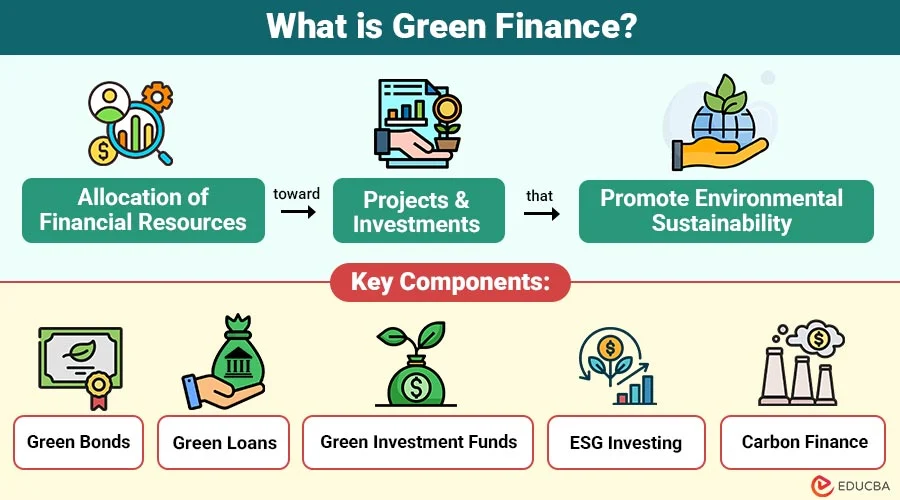
Digital-first investors who use sustainable investment approaches will experience compounded returns because they benefit from lower volatility, regulatory incentives and access to the $45 trillion transition finance pipeline.
Why Green Finance Works
Three reasons drive Sustainable Investing to capture pricing power:
- Regulatory Inevitability (EU CSRD)
- Supply Chain Transformation (annual $15T of Capital Expenditures)
- Consumer Preferences – a majority of millennials place a high priority on ESG; 72%.
Green bonds are not 'nice-to-have'; these are infrastructure debt instruments that yield 50 bps more than treasuries with a 98% lower default rate.
Transition finance is directed at 'hard to abate' sectors, i.e., steel and aviation, where greenwashing has no place. Funds that comply with the SASB filter for scope 3 emissions and provide 2.6x shareholder returns compared to their lagging counterparts. The price impact of decarbonization (the carbon delta) will create an alpha asymmetry in which early movers will enjoy compounding returns, while late movers will slowly play catch-up.

Proven Returns By Asset Class
- Equity: The MSCI ESG Leaders Index has outperformed the ACWI by 3.8% (2015-2025). Low carbon strategies have returned +11.2% as of the year to date (YTD) 2025 as compared to -1.5% for the overall market. Energy transition ETFs (ICLN) have appreciated approximately 180% as of the decade to date (YTD).
- Fixed Income: Green bonds issued in 2025 totaled $580B with greenium compressed down to 5 bps. Sustainability-linked Loans (SSLs) are linked to ESG KPIs in a way that enables Unilever to save €32M when meeting their targets.
- Private Markets: Solar has generated 21-24% IRR (10-25 year horizon) and the cost of energy efficiency retrofits have reduced energy costs by 30-50% and increased LTV 4.2x construction budgets.
Corporate Finance Transformation
In regards to CFOs re-pricing sustainability into their WACC; by complying with EU Taxonomy, they unlock €1T of green capital; therefore researcing indicates that TCFD disclosing will correspond to a 16% reduction in their Cost of Equity. Further, SASB materiality maps led to 22% margin expansion.
An example of this is Schneider Electric's Green bond ladder, which funds IoT Efficiency platforms generating €2.1B recurring revenue and assisting clients with 28% reduction in energy cost.
Additionally, as a risk transfer tool Swiss Re has developed a parametric climate insurance solution that pays out 2.8x premiums on amounts during 'transition shocks' hence providing smoothing effects for the earnings.

Institutional Capital Flows
Pension funds devote 18% of their portfolios to environmentally friendly fixed-income securities which is a 240% increase since 2020. Sovereign wealth funds (Norway and Singapore) seek to achieve a net-zero target of $3 trillion by 2030. Family offices will invest $1.2 trillion in regenerative agriculture with a projected internal rate of return (IRR) of 12%.
Private credit is the leading source of financing for the transition: there is $400 billion in climate-related venture debt that yields 15%. Carbon credit funds in the voluntary market yielded 22%.
Platform Economics: The revenue generated by green fintech companies (Aspiration and ClimateTrade) exceeded $2.8 billion during this period with an average margin of 78%.
Advocacy for regulatory tailwinds to support adoption
The EU Corporate Sustainability Reporting Directive (CSRD) opens the door to Scope 3 reporting for 50,000 companies. Capital inflows of €18 Trillion through SFDR Article 8/9 classifications. The SEC Climate Rule (2026) has a mandate for financed emissions disclosure.
The alignment with Taxonomy will create a competitive advantage for first-movers in business. The International Capital Market Association (ICMA) green bond standard will result in 41% fewer fluctuations in ratings.
Positioning for Investor Strategy
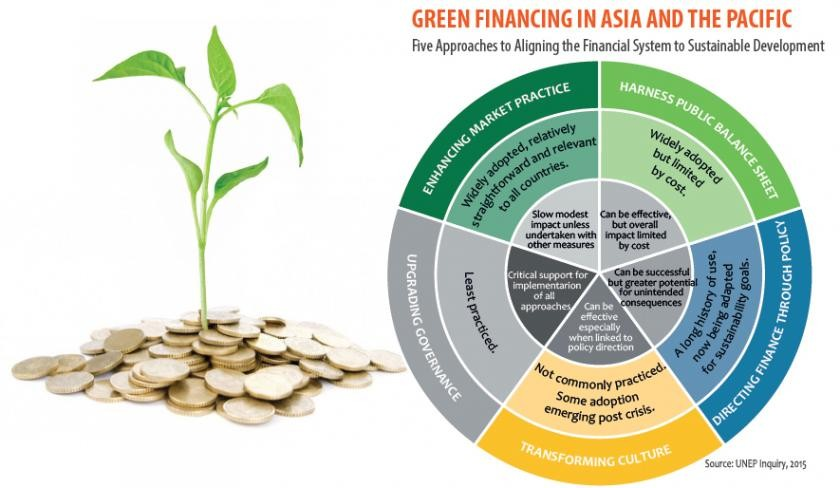
A smart portfolio construction should put 40% in green fixed income, 30% in low-carbon equities, 20% in transition credit, and 10% in climate ventures, with annual rebalancing to capture sector rotation as technology and regulations mature. The digital execution of financial management has increased with platforms like Betterment ESG using robo-advisors that automate SASB screening and platform-based, API-driven carbon accounting solutions such as Normative, which allow for real-time compliance within an investment dashboard. By not integrating ESG, laggards will pay 450 basis points more to borrow due to the systematic repricing of sustainability risk in the capital markets.
The Multi-Decade Arbitrage
Green finance products represent an opportunity to leverage three structural advantages: (1) regulatory capture that will provide first-mover advantages; (2) technological leadership that captures the highest margin transition revenue; and (3) demographic inevitability which aligns younger investors' values with the green finance revolution.
The $45 trillion in transitional spending creates an annual investment opportunity of $12 trillion—the largest capital investment wave since World War II. Sustainable investments are projected to generate an 11% compound annual growth rate (CAGR) over the next 10 years compared to 8.2% CAGR for traditional benchmarks. Sustainable investments will also display a 14% standard deviation compared to 19% for traditional portfolios.
The truth is that for digital-first investors, green investments are a default holding in their portfolios. Transitioning into the opportunity created by these capital investments represents the greatest capital spending opportunity of our generation. Placement today and compounding through 2050 is critical.
Latest Posts