
iPhone 18 Pro vs Galaxy S26 Ultra Apple's September 9 Launch Sets Up the Real Fight
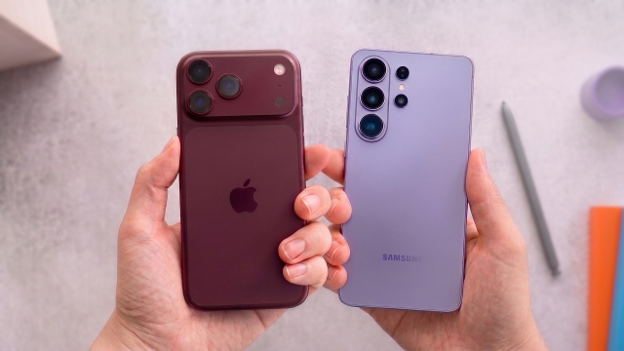
Yet this year’s September has arrived a little differently. Apple officially stepped into a new era with the first official keynote by its new CEO John Ternus, while launching its latest edition into a market that has been captured by the Galaxy S26 Ultra over the past six months.
Table of Contents
1. The Announcement, Confirmed
2. Full Spec Comparison
3. Chip and Performance
4. Cameras: Two Very Different Philosophies
5. Display and Design
6. Software and AI Features
7. Price and Availability
8. Pros and Cons
9. Which One Should You Actually Buy?
10. Conclusion
The Announcement, Confirmed
With its "Surprise and Shine" event on Wednesday, September 9, 2026, Apple unveiled the iPhone 18 Pro and iPhone 18 Pro Max while also marking the first keynote led by John Ternus, who took over as CEO from Tim Cook on September 1. Notably, Apple also decided to skip its standard iPhone 18 version entirely this cycle, and solely focused the September release towards its Pro Tier models only, with the Standard iPhone 18 not expected until Sprint 2027, while a remarkably foldable iPhone would be available starting October. Pre-orders for the pro models were opened September 12, with retail availability starting September 18 across more than 65 countries.
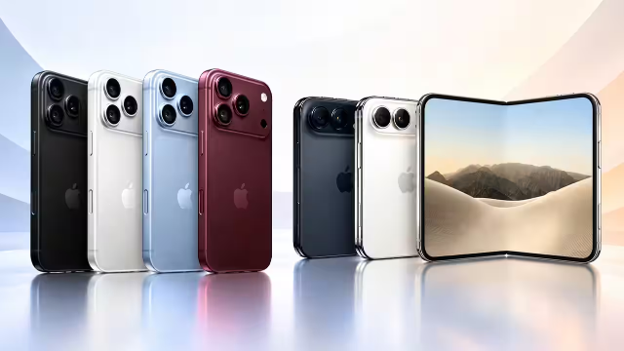
On the other hand, its biggest competitor, the Galaxy S26 Ultra has already been on the markets since March 2026, having been launched at Galaxy’s unpacked event in February. And that is sure to influence some side-by-side comparisons as they weren’t released side by side or in close proximity, but the flagship iPhone arrived to compete with a Samsung device, six months into its life cycle.
Full Spec Comparison
|
Spec |
iPhone 18 Pro |
Galaxy S26 Ultra |
|
Display |
6.3" LTPO Super Retina XDR OLED, 120Hz |
6.9" Dynamic AMOLED 2X, 120Hz, up to 3,000 nits |
|
Chip |
Apple A20 Pro (2nm) |
Snapdragon 8 Elite Gen 5 (3nm) |
|
RAM |
12GB |
12GB or 16GB |
|
Storage |
Up to 2TB |
Up to 1TB |
|
Rear cameras |
Triple 48MP (wide, ultrawide, periscope telephoto) |
Quad 200MP main + ultrawide + 3x and 5x telephoto |
|
Battery |
Larger cell than iPhone 17 Pro (exact capacity undisclosed) |
5,000mAh |
|
Charging |
Improved via C2 modem efficiency |
60W wired, 25W wireless |
|
Build |
Ceramic Shield 2 glass front, aluminum frame/back |
Corning Gorilla Armor 2, aluminum frame |
|
Water resistance |
IP68 |
IP68 |
|
Starting price |
~$1,099–$1,249 (final pricing confirmed at launch) |
$1,299 |
Chip and Performance
Apple’s A20 Pro marks a shift onto a 2-nanometer manufacturing process, with the company claiming that it allows the chip to run cooler for longer under sustainable load, with assured impacts and elevations in experience and smoothness in any tasks ranging from gaming to extended video editing. The model is further paired with Apple's new C2 modem, which Apple credits with improving overall battery efficiency alongside a larger physical battery cell.
Samsung’s Snapdragon 8 Elite Gen 5 Chip is instead built on a 3nm processor with claims of an enhanced 39% faster NPU, 24% better GPU performance, and 19% faster CPU performance over the previous Galaxy generation. It’s worth noting that while those are impressive numbers, these are Samsung’s own claims and haven’t been verified independently across every workload. Notably, Samsung also uses the Snapdragon model globally across its Samsung Ultra model, while the Samsung S26 and S26+ models run with an Exynos chip in some regions, including India, which makes establishing a genuine benchmark difficult and varied across exact model number and region.
Cameras: Two Very Different Philosophies
With the most notable differences across this category, the iPhone 18 Pro sticks with a triple 48MP camera system, prioritizing sensor quality and computational photography over raw megapixel count, while rumors also include the possibility of Apple introducing its first variable aperture camera on its recent flagship, a move that could open new capabilities for iPhone photography instead of a tiny incremental bump.
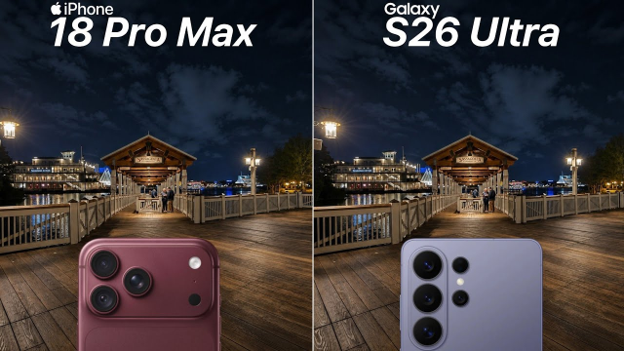
The Galaxy S26 Ultra takes an alternative direction using a 200MP main sensor with a wider f/1.4 aperture lens, marking a notable improvement on its ultrawide camera and equipping it with higher resolution than its predecessors alongside a 50MP 5x telephoto and a 3x telephoto lens as well, allowing greater and clearer zoom ranges as compared to iPhone's single periscope telephoto. In terms of pure specification range and capabilities, Samsung’s setup currently appears more versatile while Apple’s system focuses on consistency and processing quality across a smaller camera array.
Display and Design
Samsung’s Ultra continues to lead in the size comparison, with a 6.9 inch display as compared to the Iphone 18 Pro’s 6.3 inch screen, but the Pro Max version matches the Ultra’s 6.9 inch display as well, marking similarity between both larger models. Samsung's global materials cite peak brightness up to 3,000 nits, versus Apple's more conservative published figures. Regardless, the actual notable real-world outdoor visibility difference at this tier continues to remain less significantly distinct than their nit figures would otherwise suggest. In terms of their build quality, Apple's Ceramic Shield 2 and Samsung's Corning Gorilla Armor 2 are both benchmark durability glass for their companies. Both phones also carry IP68 water and dust resistance while showcasing modest dimensional changes from their prior generation, in alignment with both companies focus on durability, thermal management, and ergonomic refinement scoop over physical overhauls.
Software and AI Features
Apple's iOS 27, arriving September 14, marks an end to the long-awaited Siri overhaul built around new AI capabilities, alongside further Liquid Glass interface refinements with initial Siri AI features being limited within the English-speaking countries and further plans of extension to additional languages, marking delayed availability across the EU and China regions. Samsung's One UI 8.5, paired with what the company calls Galaxy AI 2.0, emphasizes on-device and cloud-free editing tools, real-time translation, and AI-assisted photo remastering, enhancing the blend of AI directly as compared to Apple’s more cautious integration. Additionally, Samsung has also positioned its Ultra-specific Privacy Display as a hardware-level feature that limits screen visibility to the user at extreme viewing angles, a feature that Apple doesn't currently match,
Price and Availability
Samsung held the Galaxy S26 Ultra’s starting price at flat $1,299, price that aligns with its predecessor model S25 Ultra despite pressure through rising memory chip costs and inflation prices, a move that has been welcomed well across buyers. Apple’s iPhone 18 Pro pricing has instead raised some eyebrows, with prices ranging around the $1,199 range in the US for its base 256 gb storage models, while raising prices significantly towards the larger storage tiers, considering memory cost pressures that have elevated chip pricings globally.
Conclusion
In an honest specification-to-specification comparison, both companies have decided to play safer with incremental improvements in refined chips, better cameras and display qualities instead of focusing on a dramatic redesign while pricing their top-tier models close enough to ensure ecosystem loyalty drives purchase decisions more than a single spec sheet advantage. And perhaps if you look at the ground-level comparisons between the two, both flagships are a reminder that flagship smartphones have entered a genuinely mature, incremental phase instead of providing radical elevations that you need to grab from the market at its first availability, the most useful takeaway of it all.
Latest Posts